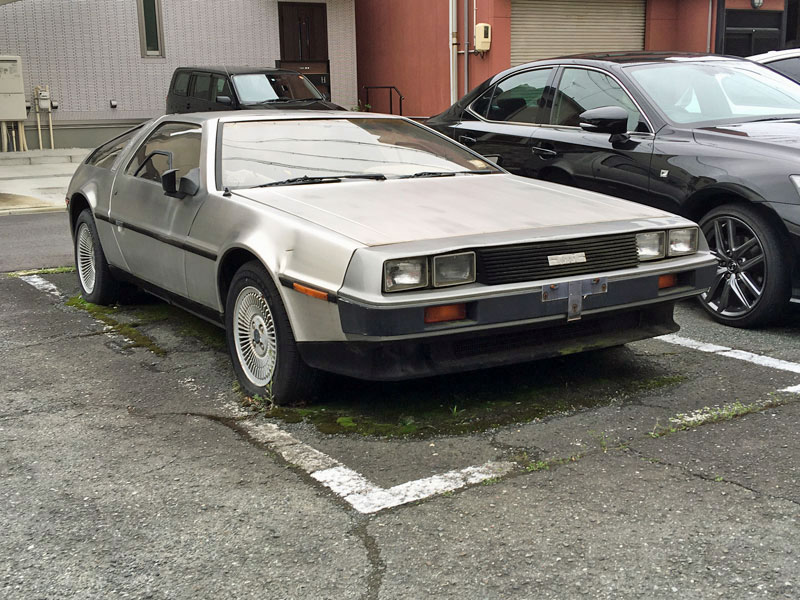
I rarely post about non-Japanese cars, but this slowly decaying DeLorean DMC12 in Japan is an exception to that rule! The DeLorean DMC12 is a very special car and it is strange to see one neglected like this. I would even say this is the US counterpart of the Fujiwara Tofu-ten special!
Neglected DeLorean DMC12 in a Japanese parking lot
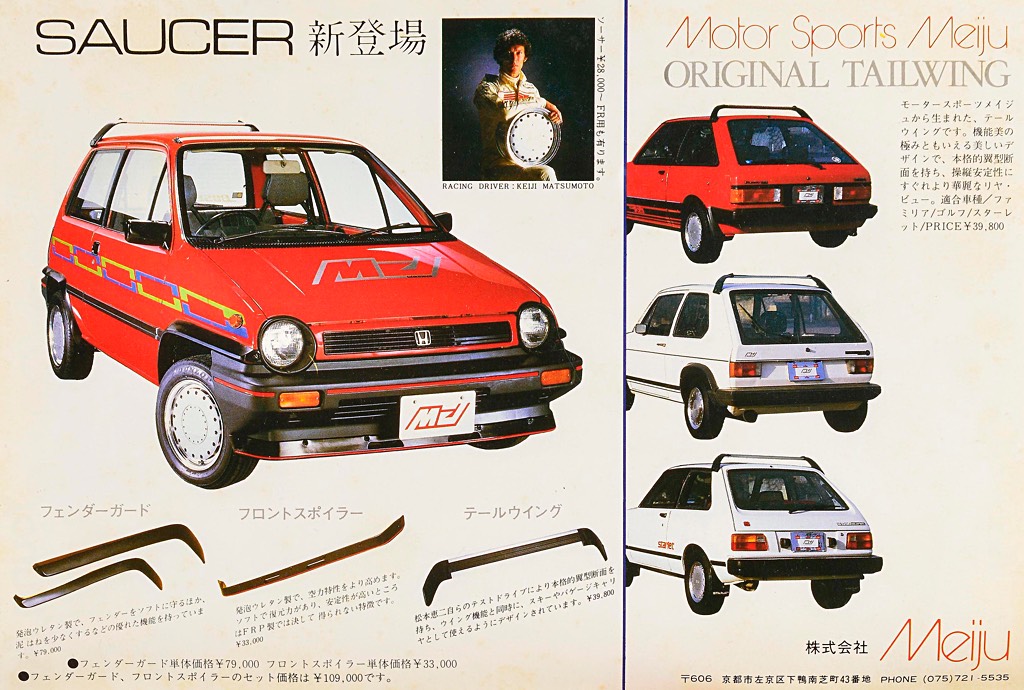
This aero kit and Saucer wheels on the Honda City was developed in the early 1980s by a tuning shop called Motor Sports Meiju in the Kyoto prefecture in Japan. 40 years onwards, it looks strange and heavily dated. It looks crude and this is not how Aero evolved over the past 40 years. So what is it and who is this Keiji dude sitting with a wheel in his lap?
1983 Motor Sports Meiju Saucer wheel ad
Motor Sports Meiju history
I guess I first have to explain what Motor Sports Meiju is. It all begins with the late racing driver Keiji Matsumoto (松本恵二). Matsumoto started his career in 1968 when he bought a used Toyota Corolla and, unbeknownst to his parents, he stripped off all unnecessary accessories and started practising on Suzuka Circuit and the Higashiyama route near his hometown of Kyoto. He debuted in 1969 in the T-1 class and worked his way up via FJ1300 to F2000, a precursor to the F2 class in 1976. In 1979 he managed to win the, by now renamed, F2 class. Shortly after this, he started his own tuning shop called Motor Sports Meiju. Matsumoto is a very well-known Japanese racing driver and featured in many Cabin Spirit ads.
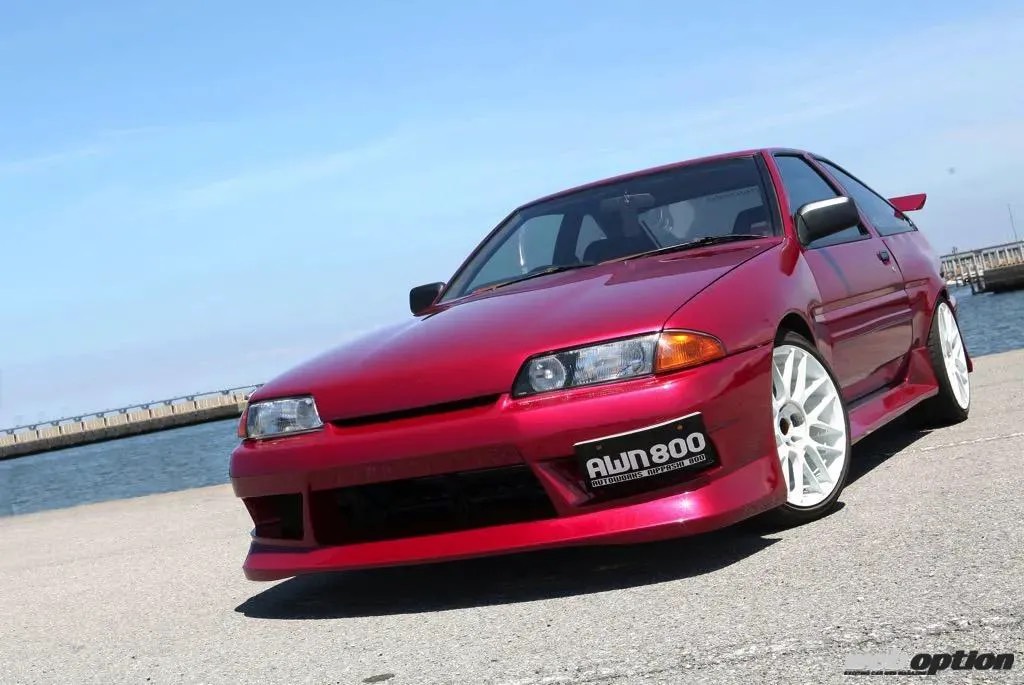
Just like last time Levin Delta Integrale, we have another face-swapped example: an AE86 with the face of a Skyline HCR32! Even though the tail lights seem to originate from a Trueno AE86, I’ll just call it the SkyLevin. It may look a bit weird as the R32 Skyline is almost a decade ahead in design, but does it look good? That’s up to you to decide!
Autoworks Nipponshi AWN 800: AE86 with Skyline HCR32 front end
Autoworks Nipponshi
Let’s start with the builder of this insane car: Autoworks Nipponshi. They called their work the AWN 800. I can understand the AWN abbreviation, but I have no idea what the 800 means. I wasn’t able to find out much about this garage. I’ve tried searching on both Romanized and Katakana, but nothing turned up except for this Motor Fan article. My guess is this was done by a small garage in the Nipponshi area without a website or any presence on the web. I’ve also tried to go through all the garages in the Nipponshi area but to no avail.
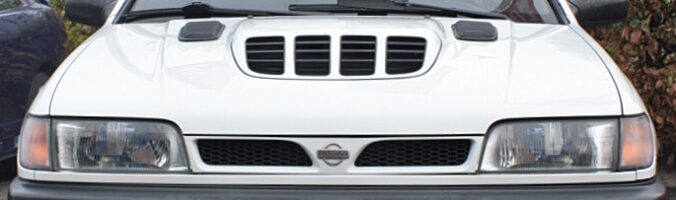
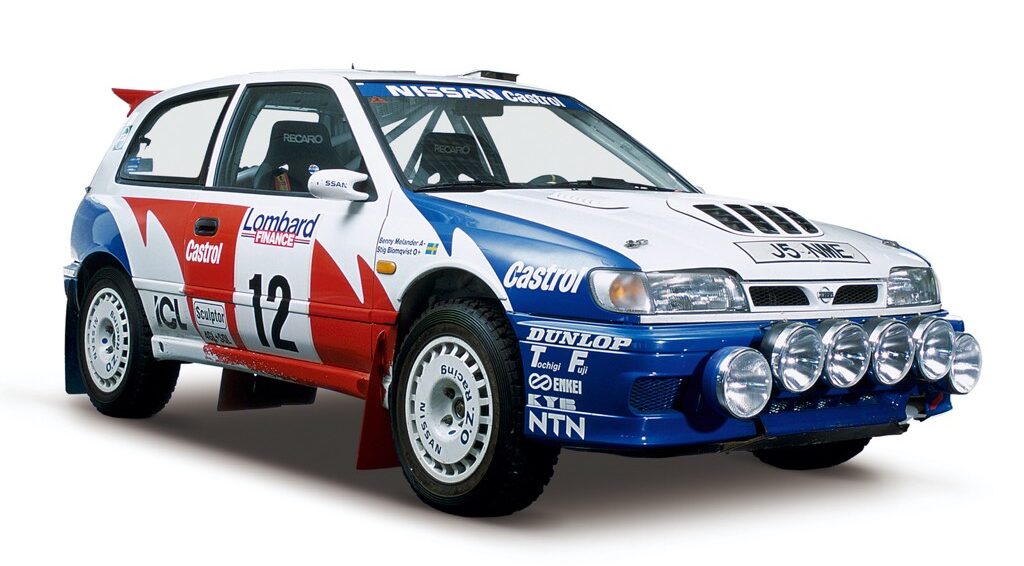
The Nissan Sunny / Pulsar GTi-R is a homologation special for Group A rallying by Nissan. Nissan had to sell 5000 cars with the same engine as the rally car to fulfil the requirements for homologation. Nissan planned to use the SR20DET as the designated engine and permanent four-wheel-drive as their drivetrain. The combination led to a small pocket rocket that was able to accelerate from 0 to 60 in 6 seconds. The GTi-R was sold overseas under the Sunny branding, while in Japan it was sold under the Pulsar branding.
Nissan Pulsar GTi-R Group A rally car
In the past, I did cover the Sunny / Pulsar GTi-R and I found it quite an impressive little car! I encountered one down on the street in 2015 and I even created two videos about this GTi-R and I’ll add them to the post below. When I recently started doing the How many are left series, I was curious how many GTi-Rs are left on the Dutch roads.
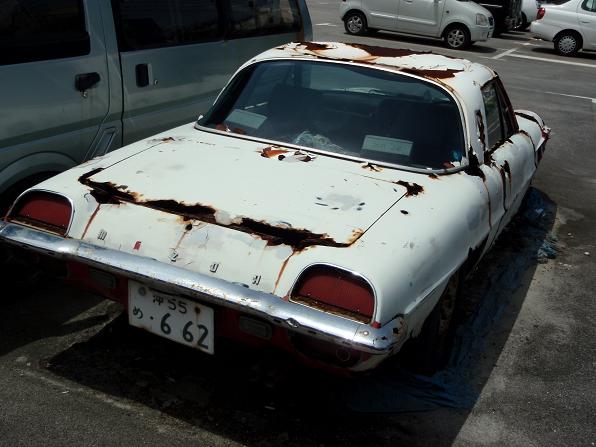
There is only some cosmetic damage on this Mazda Cosmo Sport. Nothing bad to write about. All it needs is just a little refresher on the paint. Maybe a little TLC on the suspension. And perhaps it needs a patch or two on the bodywork. But definitely not more than that!
Just some cosmetic damage on this Mazda Cosmo Sport Series II
Mazda Cosmo Series I and Series II
For those unaware what a Mazda Cosmo Sport is: when Mazda was able to create their own reliable engine from the NSU licensed engine, they needed a car to showcase it. This became the Mazda Cosmo Sport, also better known as the Mazda Cosmo 110S outside Japan, and was presented in 1964. 80 cars were extensively tested between 1965 and 1966. Only 1967 the Cosmo became available for the general public and already received a facelift in July 1968. This was then called the Series II and it only received minor changes, where the room between the door and the rear fender was extended by 1.5 inches.
This Mazda Cosmo Sport is a Series II car. In the photo above you can see the space between the door and the rear fender is longer than on the Series I car. According to the blog posts (here and here) I found this posted on, this car is located in Okinawa. We can also deduce this from the license plate 沖55 め6.62: the first character is for the Okinawa prefecture.
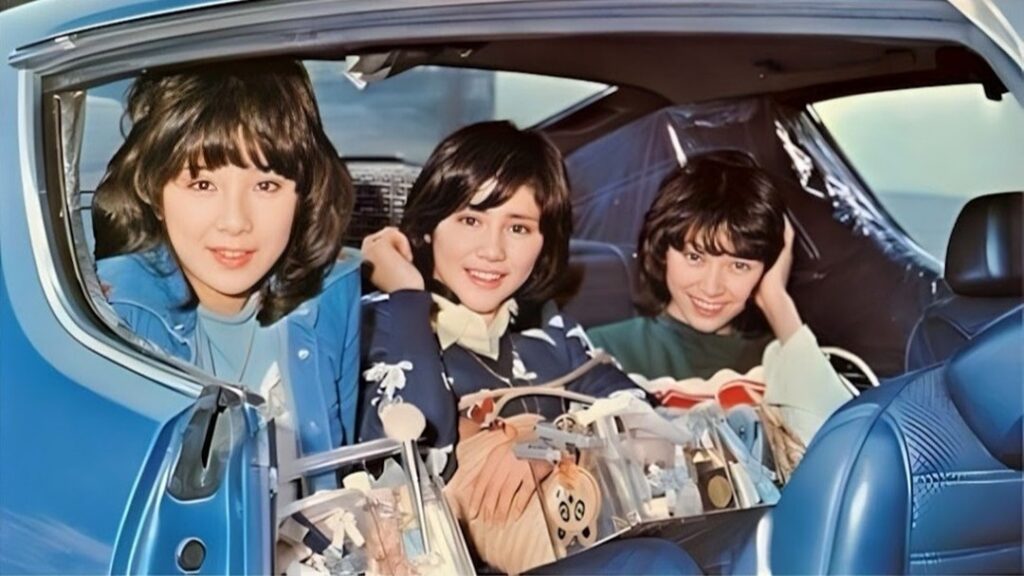
Mary and her sisters are sitting in the back of a Kenmeri Skyline. At least, that’s what I thought when I saw this photograph for the first time. But who are they? I saved it for later and fast forward a couple of years and decided to run the photo through Google Bard. That turned out to be a nice surprise!
The Candies (キャンディーズ) in the back of a Nissan Skyline C110 coupé
Google Bard identified the three women as Ran, Sue and Miki from the Japanese idol group the Candies (キャンディーズ). Here’s a photo of them in reverse order:
This website uses cookies to improve your experience. We'll assume you're ok with this, but you can opt-out if you wish.AcceptRead More
Privacy & Cookies Policy
Privacy Overview
This website uses cookies to improve your experience while you navigate through the website. Out of these, the cookies that are categorized as necessary are stored on your browser as they are essential for the working of basic functionalities of the website. We also use third-party cookies that help us analyze and understand how you use this website. These cookies will be stored in your browser only with your consent. You also have the option to opt-out of these cookies. But opting out of some of these cookies may affect your browsing experience.
Necessary cookies are absolutely essential for the website to function properly. This category only includes cookies that ensures basic functionalities and security features of the website. These cookies do not store any personal information.
Any cookies that may not be particularly necessary for the website to function and is used specifically to collect user personal data via analytics, ads, other embedded contents are termed as non-necessary cookies. It is mandatory to procure user consent prior to running these cookies on your website.